
Want to convert a percent to a decimal instead? Use the percent to decimal converter.
How to Use the Decimal to Percent Calculator
This calculator allows you to convert any decimal number into its percentage equivalent.
To use the calculator:
- Enter the decimal number you want to convert in the Decimal field.
- Click Calculate.
The calculator will instantly convert the decimal to a percentage and provide a clear, step-by-step solution, showing exactly how the result was obtained.
How to Convert a Decimal to a Percent
To convert a decimal to a percent, multiply the decimal by 100 and add the percentage symbol (%). However, you don’t need a calculator to perform this calculation. You can simply move the decimal point two places to the right.
To convert a decimal to a percentage manually, follow these steps:
- Identify the decimal point in the number.
- Move the decimal point two places to the right. Add zeros at the end if necessary.
- Add the percentage symbol (%) to the resulting number.
Example: Converting a Decimal to a Percent
Convert 0.075 to a percentage.
Solution
To convert 0.075 to a percentage by hand, follow these steps:
Step 1. Identify the decimal point
The decimal point in 0.075 is between 0 and 0.
Step 2. Move the decimal point two places to the right
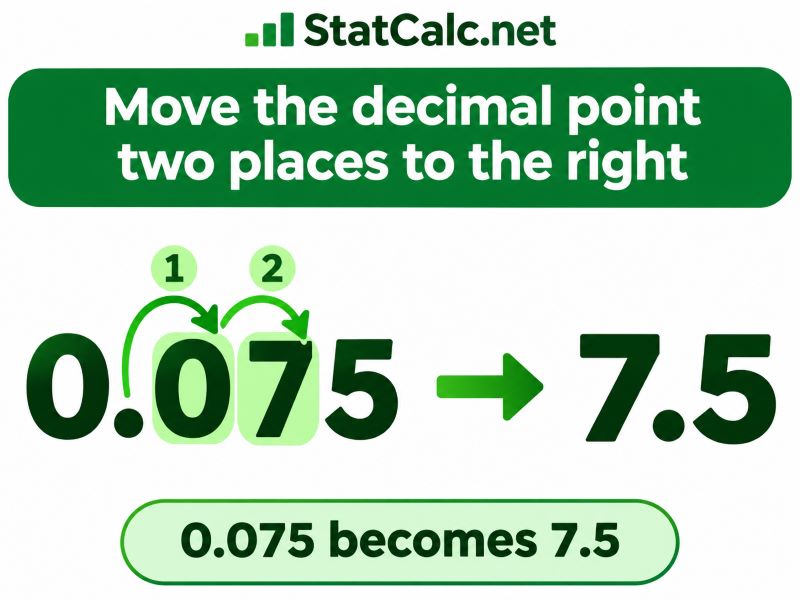
Since we are converting a decimal to a percentage, we move the decimal point two places to the right.
Moving the decimal point two places to the right changes 0.075 to 7.5. The figure below shows how to move the decimal point two places to the right.
Step 3. Add the percentage symbol
Adding the percentage symbol to 7.5 gives 7.5%.
Therefore, 0.075 as a percentage is 7.5%.
The same method applies when converting any decimal number to a percentage. For example, 0.25 becomes 25%, while 1.5 becomes 150%.
Decimal to Percent Conversion Chart
The following chart shows some common decimal numbers and their equivalent percentages.
| Decimal | Percentage |
|---|---|
| 0 | 0% |
| 0.001 | 0.1% |
| 0.005 | 0.5% |
| 0.01 | 1% |
| 0.025 | 2.5% |
| 0.05 | 5% |
| 0.075 | 7.5% |
| 0.1 | 10% |
| 0.125 | 12.5% |
| 0.2 | 20% |
| 0.25 | 25% |
| 0.5 | 50% |
| 0.75 | 75% |
| 1 | 100% |
| 1.25 | 125% |
| 1.5 | 150% |
| 2 | 200% |
As shown in the table, converting a decimal to a percentage involves multiplying the number by 100.
For example, 0.1 is equivalent to 10%, while 0.01 is equivalent to 1%.
You can use the decimal to percent calculator above to convert any decimal number that is not included in the chart.
Where Is Decimal to Percent Conversion Used?
Converting decimals to percentages is useful when expressing proportions, probabilities, interest rates, and other numerical values in percentage form.
Some common applications include:
- Converting probabilities expressed as decimals into percentages to make them easier to interpret.
- Expressing examination scores and other proportions as percentages.
- Converting interest rates from decimal form to percentages.
- Reporting statistical results, such as proportions and relative frequencies, in percentage form.
- Expressing business and financial ratios as percentages when preparing reports.
For example, a probability of 0.25 can be expressed as 25%, while an interest rate of 0.075 can be expressed as 7.5%.
Need a tool that performs several operations on percentages? Use the percentage calculator
Frequently Asked Questions
A decimal to percent calculator is an online tool used to convert decimal numbers into their equivalent percentages. Enter a decimal to get an instant answer with a clear, step-by-step solution.
To convert a decimal to a percent, multiply the decimal by 100 and add the percentage symbol. You can also move the decimal point two places to the right.
You multiply by 100 to convert a decimal to a percent. To convert a percentage back to a decimal, divide by 100 and remove the percentage symbol.
0.05 expressed as a percentage is 5%, since 0.5 × 100 = 5%.
0.005 expressed as a percentage is 0.5%, since 0.005 × 100 = 0.5%.
0.001 expressed as a percentage is 0.1%, since 0.001 × 100 = 0.1%.
No. The decimal 0.5 is equivalent to 50%, while 0.5% is equivalent to 0.005 in decimal form.
