
This calculator computes the minimum sample size needed for your study using Slovin’s formula. You only need to enter the population size and the proposed margin of error (in decimals), and the calculator will calculate the sample size for you. It will also provide you with a clear explanation of how to apply Slovin’s formula to calculate the desired sample size.
How to Use the Calculator
Using Slovin’s sample size calculator is simple. Here’s how it works:
- Enter the population size (N). This should be a whole number
- Enter the margin of error (e). You should enter the value as a decimal (eg, 0.05 for a 5% margin of error).
- Click the Calculate button. The calculator will apply Slovin’s sample size formula and display the required sample size immediately.
Note.
- The calculator provides the final sample size after rounding off to the nearest whole number
- You’ll also find a step-by-step explanation demonstrating how to apply the slovin’s formula to determine the minimum sample size.
The Slovin’s Formula
Choosing the correct sample size is an important step in any research study. If your sample is too small, your results may not be reliable. On the other hand, if it is too large, you may waste time and resources collecting unnecessary data. This is why researchers use sample size formulas to determine an appropriate number of participants.
Slovin’s formula is one of the most common sample size determination formulas. It is widely used to determine the minimum sample size when the population size is known, but little is known about the population’s variability.
The formula provides a quick and practical way to estimate a sample size using only the population size and a chosen margin of error. Because of its simplicity, you’ll find many scholars and academicians apply Slovin’s formula in academic research, surveys, and research projects.
The Slovin’s formula is:
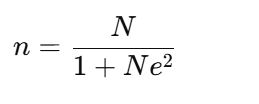
Where:
- n is the required sample size
- N is the total population size
- e is the margin of error
How to Find Minimum Sample Size Using Slovin’s Formula: Example
To better understand how to find the minimum sample size using Slovin’s formula, let’s consider the following example.
Example. Suppose a researcher wants to study households in a local community. The total number of households is 850. Studying all households is time-consuming. Thus, there is a need to use a representative sample. Now, suppose the researcher chooses a 5% margin of error.
We can manually compute the minimum sample size as follows:
By definition, Slovin’s sample size formula is:
Based on the example, we know that the population size, N = 850, and the margin of error, e = 0.05.
Substituting the values in the formula and solving, we have:
n = 272.
Since n is already a whole number, there’s no need to round up to the nearest whole number. Thus, the minimum sample size needed is 272 households.
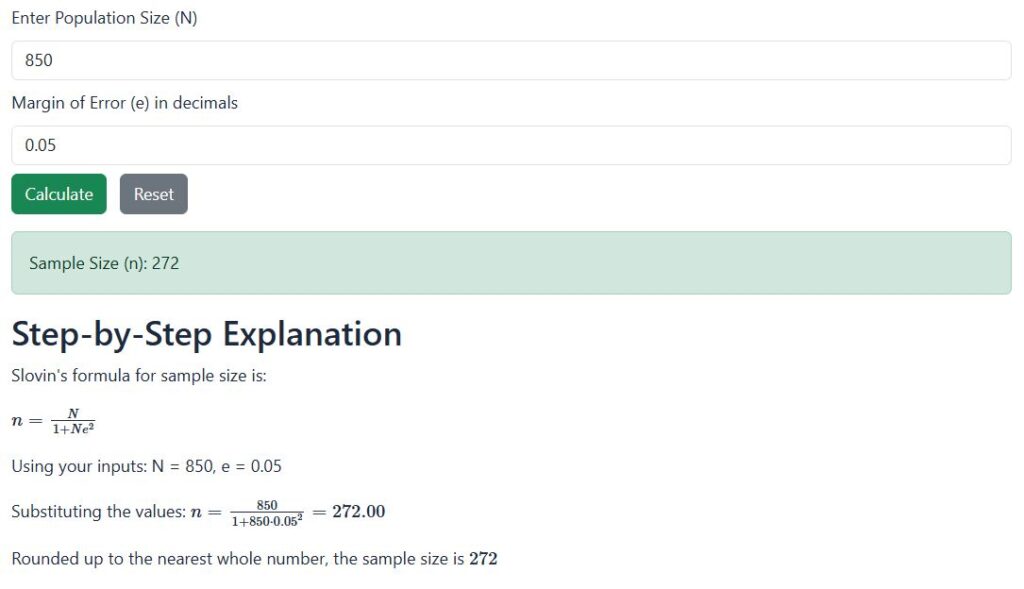
Do you really need to compute everything manually? No. We have simplified the process by providing a Slovin’s sample size calculator. To solve the same problem, simply enter the following values into the calculator:
- Population size (N): 850
- Margin of error (e): 0.05
After entering the values, click the Calculate button. The calculator will automatically apply Slovin’s formula and display the result. You will obtain the same sample size (n = 272) as follows:
When Should You Use Slovin’s Formula?
Slovin’s formula is appropriate when you need a quick and practical way to determine a sample size and only limited information about the population is available.
You should consider using Slovin’s formula when:
- The population size is known, but the population variance is unknown
- The study uses simple random sampling
- The research is preliminary, academic, or exploratory in nature
Despite its simplicity, Slovin’s formula is associated with the following limitations:
- It does not account for population variability
- It assumes random sampling, which may not hold in all studies
- It is not suitable for complex sampling designs or high-precision research
For advanced studies that require higher accuracy, more robust sample size determination methods such as Cochran’s formula may be more appropriate.