
How to Use the Percent Error Calculator
This calculator allows you to calculate the percent error between an observed (experimental) value and a true (accepted) value.
To use the calculator:
- Enter the observed or experimental value in the Observed Value (Experimental) field.
- Enter the true or accepted value in the True Value (Accepted) field.
- Click Calculate.
The calculator will instantly return the percent error, along with the absolute error and relative error. It also provides a clear, step-by-step solution, showing you exactly how the percent error was computed.
For example, suppose you want to calculate the percent error between an observed value of 79.2 and an accepted value of 80. To calculate the percent error using the calculator:
- Enter 79.2 in the observed value field.
- Enter 80 in the true value field.
- Click Calculate.
The calculator returns the following results:
- Percent Error: 1%
- Absolute Error: 0.8
- Relative Error: 0.01
This means that the observed value is 0.8 lower than the accepted value, representing an error of 1%.
Tip. This percent error calculator supports positive and negative numbers, decimals, and scientific notation. However, the true value cannot be zero because division by zero is undefined.
What Is Percent Error?
Percent error measures how far an observed or experimental value differs from a true or accepted value. It is expressed as a percentage of the accepted value’s magnitude.
Percent error is commonly used in scientific experiments to determine how close a measured result is to a known or expected value.
For example, suppose a student uses a measuring instrument to determine the length of an object whose actual length is 40 cm. The student obtains a measurement of 39 cm.
The difference between the observed and accepted values is 1 cm. However, to express this difference as a percentage of the accepted value, we divide 1 by 40 and multiply by 100. Therefore, the measurement has a 2.5% error, which means that it differs from the accepted value by 2.5% of that value.
A smaller percent error generally indicates that a measurement is closer to the accepted value, while a larger percent error indicates a greater relative difference.
Note that percent error measures how close a result is to a reference value. It does not tell us how consistent repeated measurements are.
Percent Error Formula
The percent error formula is:
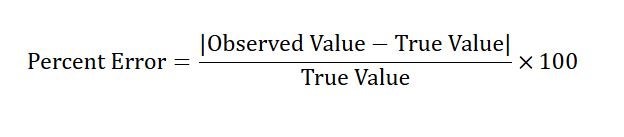
Where:
- Observed Value is the value obtained from an experiment, measurement, or estimation. It is sometimes called Experimental
- True Value, also known as accepted value, is the known, theoretical, or reference value used for comparison.
The vertical bars (| |) represent the absolute value. They ensure that the calculated percent error is nonnegative, regardless of whether the observed value is greater or less than the true value.
How to Calculate Percent Error
To calculate percent error by hand, follow these steps:
- Find the absolute error.
- Calculate the relative error.
- Multiply the relative error by 100%.
Example 1.
A student uses a digital balance to measure a reference mass of 125.0 grams. The balance gives a reading of 122.6 grams. Calculate the percent error in the measurement.
Solution
To calculate the percent error manually, follow these steps:
Step 1. Find the absolute error
By definition, the absolute error is the absolute value of the difference between the observed value and the true value.
From the question, we know that:
- Observed value = 122.6 g
- True value = 125.0 g
Therefore, absolute error = |122.6-125.0|
= 2.4 g
Step 2. Calculate the relative error
To find the relative error, we divide the absolute error by the absolute value of the true value.
Therefore, Relative Error = 2.4/|125.0|
= 0.0192
Step 3. Calculate the percent error
To find the percent error, we multiply the relative error by 100%.
Hence, Percent Error = 0.0192 × 100%
= 1.92%
Therefore, the percent error is 1.92%. This means that the measured mass is 1.92% lower than the accepted mass.
Example 2.
During a laboratory experiment, a student determines the density of a liquid as 1.028 g/mL. The accepted density for the liquid under the experimental conditions is 1.010 g/mL. Calculate the percent error.
Solution
From the question:
- Observed value = 1.028 g/mL
- True value = 1.010 g/mL
The percent error formula is:
Substituting the values gives:
Percent Error = (|1.028 − 1.010|/1.010) × 100%
= (0.018/ 1.010) × 100%
= 1.78.%
Therefore, the percent error is approximately 1.78%.
What is a good percent error?
A smaller percent error generally indicates a measurement closer to the accepted value. However, there is no universal cutoff for a good percent error. Whether an error is acceptable depends on the experiment, measuring instruments, and required accuracy.
Percent Error vs. Absolute Error vs. Relative Error
Percent error, absolute error, and relative error are closely related, but they express measurement errors differently. Each of them is described below.
- Absolute Error. Absolute error measures the size of the difference between an observed value and a true or accepted value. Its formula is
- Relative Error. Relative error expresses the absolute error relative to the magnitude of the true value. The formula is:
- Percent Error. Percent error is the relative error expressed as a percentage.
Percent Error vs. Percentage Difference
Percent error compares an observed or experimental value with a known true or accepted value. The accepted value is used as the reference when calculating the percentage.
On the other hand, Percentage difference compares two values without treating either one as the correct or accepted value. It expresses the absolute difference relative to the average magnitude of the two values.
For example, suppose two students measure the length of an object and obtain 24.5 cm and 25.1 cm. If the actual length of the object is known, you can calculate the percent error for each student’s measurement. However, if the true length is unknown and you only want to compare the two measurements, percentage difference is more appropriate.
Want an online tool that computes percentage difference and shows the steps? Use the Percentage Difference Calculator.
Where Is Percent Error Used?
Percent error is commonly used when an observed or measured value needs to be compared with a known or accepted reference value.
Some common applications include:
- Chemistry experiments: Comparing experimentally determined properties, such as density or concentration, with accepted reference values.
- Physics experiments: Evaluating the difference between measured quantities, such as acceleration, distance, or speed, and their expected values.
- Laboratory instrument calibration: Determining how far an instrument’s reading differs from a known reference standard.
- Engineering: Comparing measured dimensions or other quantities with specified reference values.
- Estimation: Evaluating how far an estimated quantity differs from an actual known value.
Percent error is useful for evaluating the accuracy of an individual measurement. However, when you have repeated measurements, you may also need to evaluate their precision.
For example, you can use the Standard Deviation Calculator to measure how spread out repeated observations are, or the Relative Standard Deviation Calculator to express their variability relative to the mean.
Frequently Asked Questions
A percent error calculator is an online tool used to calculate the percentage error between an observed or experimental value and a true or accepted value. Enter both values to get the percent error, absolute error, relative error, and a step-by-step solution showing how the answer was calculated.
To calculate percent error, subtract the accepted value from the observed value and take the absolute value of the difference. Divide the result by the absolute value of the accepted value, then multiply by 100%.
The percent error formula is: Percent Error = (|Observed Value − True Value|/ True Value) × 100%. The observed value is also called the experimental or measured value, while the true value may be called the accepted or theoretical value.
To calculate relative error, divide the absolute error by the absolute value of the accepted value. For example, if the absolute error is 3 and the accepted value is 60: Relative Error = 3/60 = 0.05. Therefore, the relative error is 0.05, which is equivalent to a percent error of 5%
Relative error expresses the absolute difference between the observed and accepted values as a ratio of the accepted value’s magnitude, while percent error expresses the same ratio as a percentage.
Percent error is usually rounded according to the precision required for the experiment or assignment. For example, a calculated percent error of 2.7468% rounded to two decimal places is 2.75%. You can use the Rounding Calculator to round the result to the required decimal places.
