
Z Table – Standard Normal Distribution Table
How to Use this Interactive Standard Normal Table
This standard normal table is a left-tail table. It helps you find the probability to the left of z (i.e., P (Z<z)). In other words, each table value gives the area to the left of the selected z-score.
To read the table, split the z-score into two parts:
- Use the left column for the ones digit and first decimal place.
- Use the top row for the second decimal place.
- Find the value where the row and column meet.
For example, suppose you want to find the probability to the left of z = 1.56, i.e., P(Z < 1.56). To find the correct probability using the z table, follow the steps:
- Look up 1.5 in the row and 0.06 in the column of the positive z-table
- Identify the value at the intersection. The table value is 0.9406
- Therefore, P(Z < 1.56) = 0.9406
Alternatively, with our interactive z-table, you can simply enter 1.56 as the z-score, and it will automatically highlight the correct probability in the positive z-table as 0.9406
This means about 94.06% of standard normal values fall below 1.56.
Tip. If you are using the interactive table above, you can also hover over a value to see the matching z score, probability, and shaded area on the normal curve.
Want to find a probability without looking it up manually? Use the z-score probability calculator.
What Is a Standard Normal Table/Z-table?
A standard normal table, or simply a z-table, is a statistical table used to find probabilities for z scores in the standard normal distribution. The table is also commonly called a z table, standard normal distribution table, z-score table, z score chart, standard normal table, standard normal probability table, or normal distribution table.
Each value in the table gives the area under the normal curve to the left of a z score, written: P(Z ≤ z). For example, the table value for z = 1.00 is 0.8413. Therefore, P(Z ≤ 1.00) = 0.8413. This means about 84.13% of values in the standard normal distribution fall at or below z = 1.00.
A z table can be used to find probabilities below or above a z score, probabilities between z scores, percentiles, and critical z values used in confidence intervals and hypothesis tests.
Note: A standard normal table works with z scores. If your problem gives a raw value, you must first convert it to a z score using the z-score calculator.
Positive and Negative Z Score Tables
The standard normal distribution extends on both sides of its mean, z = 0. For easier lookup, the table on this page is separated into a positive z-score table and a negative z-score table.
- Use the positive z table for z scores greater than or equal to 0.
- Use the negative z table for z scores below 0.
Both tables are cumulative left-tail tables. This means every value given by the table is the area to the left of z, denoted by P(Z ≤ z)
The standard normal distribution is also symmetric around z = 0. Therefore, if you know how to use one of the tables, you can still find probabilities for z scores with the opposite sign.
The symmetry relationship is: P(Z ≤ −z) = 1 − P(Z ≤ z). For instance, if P(Z ≤ 1.25) = 0.8944, then P(Z ≤ −1.25) = 1 − 0.8944 = 0.1056.
How to Read a Z Table
To read a z table, split the z score into two parts. The left column gives the ones digit and first decimal place, while the top row gives the second decimal place.
For example, suppose you want to find: P(Z ≤ 1.56)
To locate z = 1.56:
- Find 1.5 in the left column.
- Find 0.06 across the top row.
- Find the value where the 1.5 row and 0.06 column meet.
The table value is: 0.9406. Therefore, P(Z ≤ 1.56) = 0.9406
This means about 94.06% of standard normal values fall at or below z = 1.56.
If you are using the interactive z table above, simply enter 1.56 as the z score. The table will automatically highlight the correct row, column, and probability.
Tip: You can also hover over a table value to see the corresponding z score, probability, and shaded area under the normal curve.
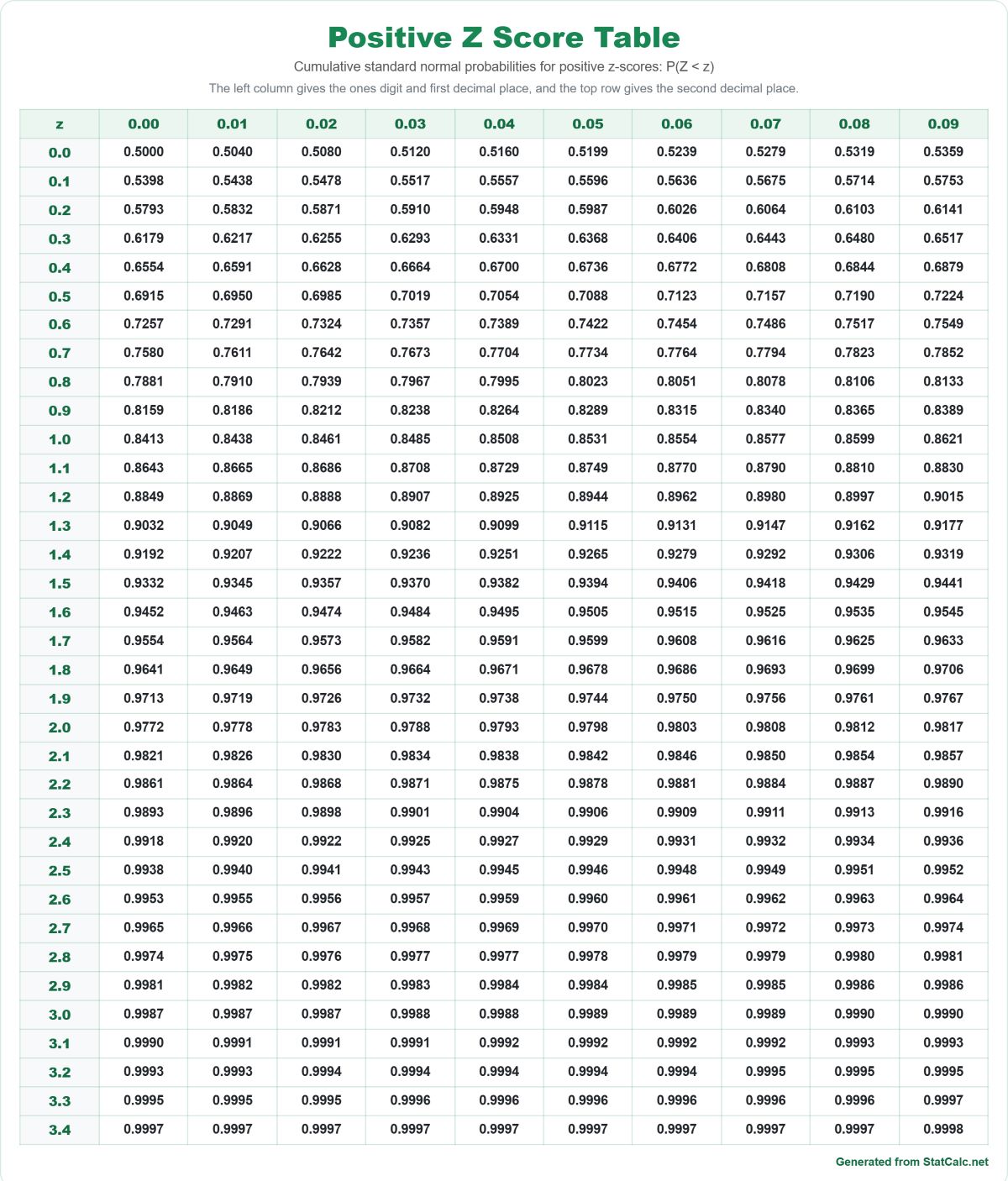
Positive Z Score Table
A positive Z-score table is a statistical chart that shows the cumulative probability, or area under the standard normal curve, for positive z-scores (z > 0). Each value in the table gives the probability that Z is less than or equal to a particular positive z-score, written P(Z ≤ z).
Since a positive z-score represents a value above the mean, the cumulative probabilities in the positive Z table are greater than 0.5000. For example, P(Z ≤ 1.00) = 0.8413, which means about 84.13% of values in the standard normal distribution fall at or below z = 1.00.
The positive Z table is easiest to use when you want to look up probabilities for z-scores greater than 0. However, because the standard normal distribution is symmetric, you can also use the positive table to find probabilities for negative z-scores, as shown in Example 2 below.
The positive z table is shown below.
Example 1: Using the Positive Z Table for a Positive Z Score
Using a positive z-score table, find P(Z ≤ 1.25)
Solution
Since z = 1.25 is positive, the most suitable table to use is the positive z table. Using the table:
- Find 1.2 in the left column.
- Find 0.05 in the top row.
- Read the probability where the row and column meet.
The table gives 0.8944, as shown below.
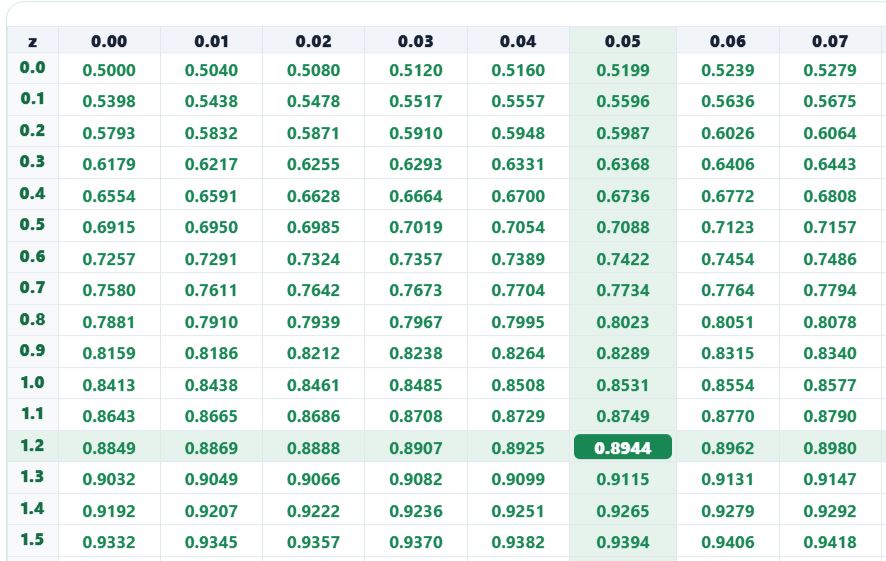
Therefore, P(Z ≤ 1.25) = 0.8944
This means about 89.44% of values in the standard normal distribution fall at or below z = 1.25.
Example 2: Using the Positive Z Table for a Negative Z Score
Use the positive z table to find P(Z ≤ −1.25)
Solution
The positive z table does not list −1.25 directly. However, we can look up the corresponding positive z score and use symmetry.
From the positive table: P(Z ≤ 1.25) = 0.8944. Using symmetry, the area to the left of −1.25 is equal to the area to the right of 1.25.
Therefore, P(Z ≤ −1.25) = 1 − P(Z ≤ 1.25)
= 1 − 0.8944
= 0.1056
Hence, P(Z ≤ −1.25) = 0.1056
This shows that you can use a positive z table even when the z score is negative.
Negative Z Score Table
A negative Z-score table is a statistical chart that shows the cumulative probability, or area under the standard normal curve, for negative z-scores (z < 0). Each value in the table gives the probability that Z is less than or equal to a particular negative z-score, written P(Z ≤ z).
Since a negative z-score represents a value below the mean, the cumulative probabilities in the negative Z table are less than 0.5000. For example, P(Z ≤ −1.00) = 0.1587, which means about 15.87% of values in the standard normal distribution fall at or below z = −1.00.
The negative Z table is easiest to use when you want to look up probabilities for z-scores below 0. However, you can also use it to find probabilities for positive z-scores by using the symmetry of the standard normal distribution, as shown in Example 4 below.
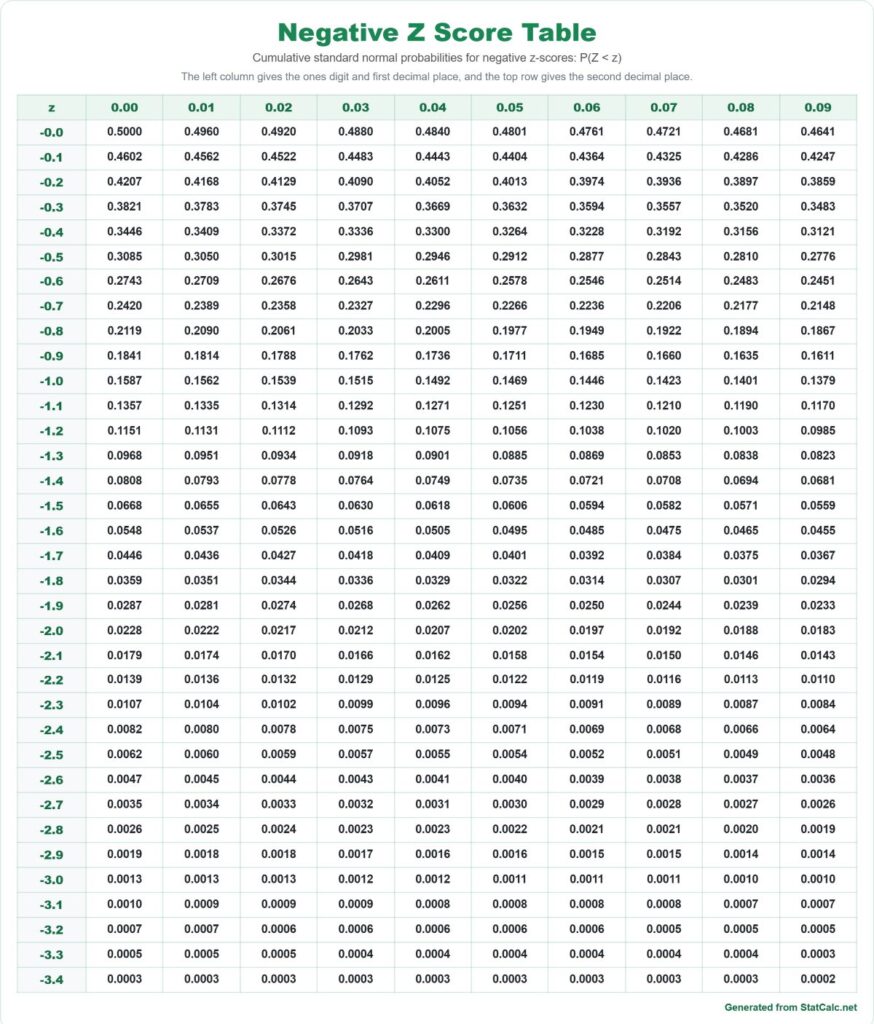
Note. Because negative z scores fall below the mean, their cumulative probabilities are less than 0.5000.
Example 3: Using the Negative Z Table for a Negative Z Score
Using a negative z-score table, find P(Z ≤ −0.84)
Solution
Since z = −0.84 is negative, we need to use the negative z table. Using the table:
- Find −0.8 in the left column.
- Find 0.04 in the top row.
- Read the probability where the row and column meet.
The table gives 0.2005, as shown below.
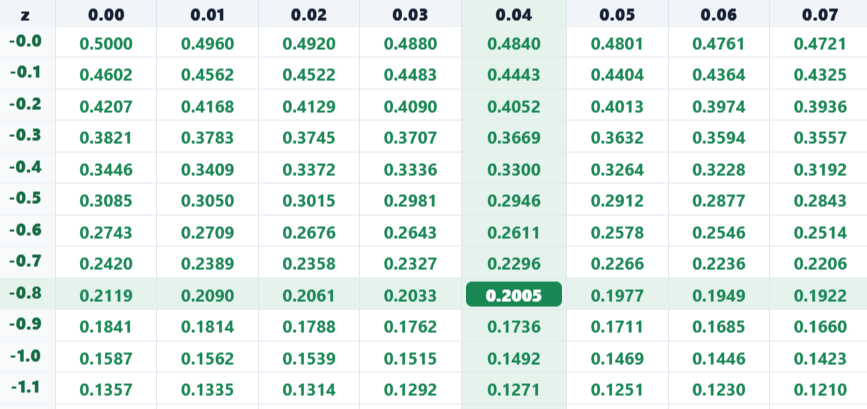
Therefore, P(Z ≤ −0.84) = 0.2005
This means about 20.05% of values in the standard normal distribution fall at or below z = −0.84.
Example 4: Use the Negative Z Table for a Positive Z Score
Using the negative z table, find P(Z ≤ 0.84)
Solution
To find the required probability, we need to first use the negative table to look up the corresponding negative z score: z = −0.84
The table gives: P(Z ≤ −0.84) = 0.2005
Using the symmetry of the standard normal distribution: P(Z ≤ 0.84) = 1 − P(Z ≤ −0.84)
= 1 − 0.2005
= 0.7995
Therefore, P(Z ≤ 0.84) = 0.7995
This shows that a negative z table can also be used to find probabilities for positive z scores.
Want a printable copy of both tables? Download the complete Z table PDF, which includes the positive and negative Z-score tables in one document. You can save it for offline use, print it for class, or use it when solving statistics problems.
How to Find Probability from a Z-score Using a Z-score Table
Once you have a z-score, you can use a z-score table to find the probability associated with that value. Since the table on this page gives cumulative left-tail probabilities, the value you look up represents the area under the standard normal curve to the left of the z-score, P(Z ≤ z).
Depending on the question, you may need the probability to the left of a z-score, to the right of a z-score, or between two z-scores. Left-tail probabilities can be read directly from the table, while right-tail and between probabilities require a simple calculation using the cumulative probabilities from the table.
The section below shows how to find each type of probability.
1. Left-Tail Probability
Left-tail probability is the area to the left of a z score. Since this is a left-tail standard normal table, you can read this probability directly from the table.
Example 1. Find P(Z ≤ 1.23)
To find P(Z ≤ 1.23), we use the positive z-table and follow these steps:
- Find row 1.2.
- Find column 0.03.
- The value at the intersection is 0.8907.
Therefore, P(Z ≤ 1.23) = 0.8907. This means about 89.07% of values fall below z = 1.23.
Example 2. Find P(Z ≤ -0.84)
To find P(Z ≤ -0.84), we use the negative z-table and follow these steps:
- Find row -0.8
- Find column 0.04.
- The table value at the intersection is 0.2005.
Therefore, P(Z ≤ -0.84) = 0.2005. This means about 20.05% of values fall below z = -0.84.
2. Right-Tail Probability
Right-tail probability is the area to the right of a z score. A left-tail table does not give this value directly, but it is easy to calculate. To find the right-tail probability using z-tables, we use the formula: P(Z ≥ z) = 1 – P(Z ≤ z)
Example: Find P(Z ≥ 1.96)
To find P(Z ≥ 1.96) using z-tables, follow these steps:
Use a positive z-table and look up 1.96. This gives P(Z ≤ 1.96) = 0.9750
Since we want to find P(Z ≥ 1.96), we apply the formula: P(Z ≥ z) = 1 – P(Z ≤ z)
Thus, P(Z ≥ 1.96) = 1 – 0.9750
= 0.0250
This implies that the probability of getting a z score greater than 1.96 is 0.0250, or 2.50%.
3. Probability Between Two Z Scores
To find the probability between two z scores, look up both cumulative probabilities and subtract the smaller value from the larger value. In other words, P(a ≤ Z ≤ b) = P(Z ≤ b) – P(Z ≤ a)
Example: Find P(-1.00 ≤ Z ≤ 1.00)
To find the above probability, we need to apply the above formula.
Thus, P(-1.00 ≤ Z ≤ 1.00) = P(Z≤ 1.00) – P(Z≤ -1)
Looking up the probabilities using both positive and negative z-tables, we get:
- P(Z ≤ 1.00) = 0.8413
- P(Z ≤ -1.00) = 0.1587
Therefore, P(-1.00 ≤ Z ≤ 1.00) = 0.8413 – 0.1587
= 0.6826
This implies that about 68.26% of values in the standard normal distribution fall between z = -1 and z = 1.
This result is closely related to the empirical rule, which says that about 68% of values in a normal distribution fall within one standard deviation of the mean.
How to Find a Z Score from a Probability Using the Table
Sometimes you already know the probability and want to find the z-score. This is the reverse of looking up a probability from a z-score.
To find a z score from a probability using the z-tables, follow these steps:
- Look inside the body of the standard normal table for the probability closest to your given value.
- Read the row and column that match that table value.
For example, suppose you want to find the z score for a left-tail probability of 0.9750. You can do this as follows:
- Look through the table until you find 0.9750. It appears at row 1.9 and column 0.06.
- Combine the row and column: 1.9 + 0.06 = 1.96
Therefore, P(Z ≤ 1.96) = 0.9750. This means the z-score for a cumulative probability of 0.9750 is 1.96.
Need a More Precise Z Score?
A standard normal table is useful for learning how probability and z-scores are connected. However, table values are usually rounded to four decimal places. This means that the z-score you find may only be approximate.
If your probability is not listed in the table, or you need a more precise inverse normal value, use the inverse normal distribution calculator. It lets you enter a left-tail, right-tail, or between-area probability and find the matching z score with steps.
How to Convert a Raw Value to a Z Score
The standard normal table works with z scores, not raw data values. If you have a raw value, you need to first convert it to a z-score. The z-score formula is z = (x – μ) / σ
Where:
- x is the raw value
- μ is the population mean
- σ is the population standard deviation
Example: Suppose a test has:
- Mean = 70
- Standard deviation = 10
- Student score = 85
The z score is:
z = (85 – 70) / 10 = 1.50
However, if you want a quick way to apply the formula, you can use the z-score calculator.
When Should You Use a Standard Normal Table?
Use a standard normal distribution table when your problem involves a normal distribution, and you need a probability from a z score.
It is commonly used in:
- Introductory statistics courses
- Probability problems
- Normal distribution questions
- Confidence intervals
- Z tests
- P-value calculations
- Percentile calculations
- Quality control and process analysis
However, the table is only appropriate after values are standardized. If your problem gives raw scores, remember to first convert them into z scores using the mean and standard deviation.
For example, a value of 80 does not mean anything by itself in a z table. You need to know how far 80 is from the mean in standard deviation units.
Why Use This Interactive Z Table?
Most standard normal tables are static. You have to search for the row and column manually, then work out what the probability means on your own.
This interactive z-table makes the process easier. When you hover over a table value, you can see the matching z score, probability, and shaded area on the normal curve. This helps you understand the result instead of only copying a number from the table.
You can use this table to:
- Find left-tail probabilities from z scores
- Compare positive and negative z values
- See how the shaded area changes across the normal curve
- Understand percentiles and cumulative probabilities
- Download the z tables as PDF for offline use
The table is especially helpful for students because it connects the numbers in the table with the visual area under the curve. That makes it easier to avoid common mistakes, such as confusing left-tail and right-tail probabilities or forgetting how negative z scores work.
For faster calculations, you can also use the input fields above the table to find a probability from a z score or find a z score from a probability.
Frequently Asked Questions
A standard normal distribution table shows cumulative probabilities for z scores. In a left-tail table, each value gives P(Z ≤ z), which is the probability that a standard normal value is less than or equal to the selected z score.
Yes. A z table, standard normal table, and standard normal distribution table usually refer to the same type of table. They all help you find probabilities from z-scores in the standard normal distribution.
Find the row for the z score’s first decimal place, then find the column for the second decimal place. The value where the row and column meet is the cumulative left-tail probability.
For z = 1.96, the left-tail probability is 0.9750. This means 97.50% of values fall below z = 1.96. The right-tail probability is 1 – 0.9750 = 0.0250.
Look up the left-tail probability in the table, then subtract it from 1. For example, if P(Z ≤ 1.25) = 0.8944, then P(Z ≥ 1.25) = 1 – 0.8944 = 0.1056.
Look up both z scores in the table and subtract the smaller cumulative probability from the larger cumulative probability. For example, P(-1 ≤ Z ≤ 1) = 0.8413 – 0.1587 = 0.6826.