
How to Use the Geometric Mean Calculator
This calculator helps you find the geometric mean of a set of positive values instantly. To use the calculator:
- Enter your data values in the input box. Separate the values using commas, spaces, tabs, or line breaks. You can also copy-paste values directly from Excel, Google Sheets, or even text documents.
- Click Calculate.
The calculator will instantly return the correct geometric mean for your data. Want to learn how to get the same answer either using the product and nth root method or the logarithmic method? You can switch between either of the methods to view the step-by-step solution of any of the methods.
Note. Both methods give the same geometric mean. The product method is usually easier for small datasets, while the logarithmic method is useful when working with many values or very large products.
Geometric Mean: Definition & Formulas
The geometric mean is a type of average that finds the central tendency of a set of values by multiplying them rather than adding them. It is highly useful for datasets involving percentages, ratios, or exponential growth, such as investment returns or population growth rates.
Unlike the arithmetic mean, which adds values and divides by the number of values, the geometric mean multiplies the values and then takes the nth root of the product. In this case, the Geometric mean formula is:

Where:
- GM is the geometric mean.
- x₁, x₂, …, xₙ are the positive data values.
- n is the total number of values.
- ⁿ√ means the nth root.
The same formula can also be written as:
GM = (x₁ × x₂ × … × xₙ)1/n
However, for large datasets, multiplying many values can result in a very large product. In this case, the geometric mean formula is modified and rewritten using logarithms to make the calculation easier to manage, while still getting the same result.
Therefore, the geometric mean formula using the logarithmic approach is:
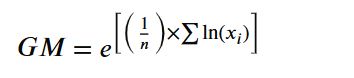
Where:
- ln(xᵢ) is the natural logarithm of each value.
- Σ ln(xᵢ) is the sum of the natural logarithms.
- n is the total number of values.
- e is Euler’s number, approximately 2.71828.
How to Calculate the Geometric Mean
There are two common ways to calculate the geometric mean manually:
- Product and nth Root Method
- Logarithmic Method
Both methods give the same answer. The calculator lets you understand how to find the geometric mean by switching between these two methods in the step-by-step solution.
To help you grasp the concepts, we’ll use the following example question to demonstrate how to find the geometric mean using both methods, step-by-step.
Example. Find the geometric mean of the following values:
4, 9, 16
Method 1: Product and nth Root Method
To find the geometric mean for the above data using the product and nth root method, follow these steps:
Step 1: State the geometric mean formula.
By definition, the geometric mean formula is: GM = n√(x₁ × x₂ × … × xₙ)
Step 2: Substitute the values into the formula and solve
Substituting the values into the formula and solving, we get:
GM = 3√(4 × 9 × 16)
= 3√(4 × 9 × 16)
= 3√576
Hence, GM = 8.320335
Therefore, using the product and nth root method, the geometric mean, GM = 8.320335
Method 2: Logarithmic Method
To find the geometric mean using the logarithmic approach, follow these steps:
Step 1: State the logarithmic formula.
By definition, the logarithmic formula for the geometric mean is: GM = e[(1/n) × Σ ln(xᵢ)]
Step 2: Find the natural logarithm of each value.
Using natural logarithms:
- ln(4) = 1.386294
- ln(9) = 2.197225
- ln(16) = 2.772589
Step 3: Add the natural logarithms.
Σ ln(xᵢ) = 1.386294 + 2.197225 + 2.772589
= 6.356108
Step 4: Divide by the number of values.
There are 3 values. Hence n = 3. Therefore, (1/n) × Σ ln(xᵢ) = 6.356108 / 3
= 2.118703
Step 5: Raise e to the result.
GM = e2.118703
= 8.320335
Therefore, using the logarithmic method, the geometric mean, GM = 8.320335
Both methods gives the same geometric mean. If you’re working with a small dataset, use the product-nth root method. However, if you’re working a large dataset, the logarithmic formula is more appropriate.
When to Use the Geometric Mean?
The geometric mean is appropriate when working with values either related by multiplication, ratios, or compound change. Therefore, it is particularly useful when working with:
- Growth factors over time
- Ratios and relative changes
- Index numbers
- Compound growth rates
- Repeated proportional changes
- Data that vary by multiplication instead of addition
Want to simply find the sample mean or population mean of your dataset? The mean calculator might be useful. However, if your data has corresponding weights, you should use the weighted mean calculator.
Geometric Mean vs Arithmetic Mean
The geometric mean and arithmetic mean are both averages, but they are not used in the same situations. The table below shows the key differences between the geometric mean and the arithmetic mean.
| Type of mean | How it is calculated | Best used when |
|---|---|---|
| Arithmetic mean | Add all values and divide by the number of values | Values are added or compared directly |
| Geometric mean | Multiply all values and take the nth root | Values are multiplied, compounded, or expressed as ratios |
Frequently Asked Questions
This calculator finds the geometric mean of a set of positive values and shows a step-by-step solution. The step-by-step solution allows you to switch between the product-nth root method or the logarithmic method.
The geometric mean is an average found by multiplying all values together and taking the nth root of the product.
The formula is: GM = ⁿ√(x₁ × x₂ × … × xₙ), where n is the number of values and x₁ × x₂ × … × xₙ is the product of all values in your dataset.
The logarithmic formula is: GM = e^[(1/n) × Σ ln(xᵢ)]. This method uses natural logarithms and gives the same result as the product-nth root method.
No. The arithmetic mean adds values and divides by the number of values. On the other hand, the geometric mean multiplies values and takes the nth root.
No. This calculator focuses on the classical geometric mean, which is normally used with positive values.
