
How to Use the Harmonic Mean Calculator
This calculator provides a quick way to find the harmonic mean for a set of positive values. To use the calculator:
- Enter your data values in the input box. Make sure to separate the values using commas, spaces, tabs, or line breaks. You can also paste values directly from Excel, Google Sheets, or text documents
- Click Calculate.
The calculator will instantly return the harmonic mean for your data and show you exactly how the value was obtained using this data. Therefore, this tool ensures you not only get the correct answer but also learn how to find the harmonic mean manually.
What Is Harmonic Mean?
The harmonic mean is a type of average that is based on reciprocals. It is defined as the reciprocal of the arithmetic mean of the reciprocals of a given set of values.
The harmonic mean is useful when the values are rates, ratios, or quantities where “per unit” matters. For example, it is often used with speeds, rates of work, densities, financial ratios, and similar data.
Therefore, you should use the harmonic mean when you want to find the average for smaller values, which are assumed to have more influence on the final results.
Harmonic Mean Formula
For a dataset containing (n) values (where every value (x > 0)), the harmonic mean formula is:
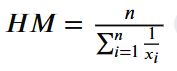
Where:
- HM is the harmonic mean.
- xᵢ is each positive data value.
- n is the total number of values.
- Σ(1 / xᵢ) is the sum of the reciprocals of all values.
Sometimes, the Σ(1 / xᵢ) is written in expanded form. In this case, the formula becomes:
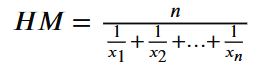
Note. This calculator uses the classical harmonic mean formula defined above. As such, all the data values should be non-zero and positive.
How to Calculate the Harmonic Mean
To calculate the harmonic mean manually:
- Count the number of values to get n
- Find the reciprocal of each value.
- Add the reciprocals.
- Apply the harmonic mean formula
Example 1
Find the harmonic mean of the following values:
12, 16, 18, 22, 17, 14, 8
Solution
To find the harmonic mean of the above data by hand, follow these steps:
Step 1: Count the number of values
From the dataset, there are 7 observations. Hence, n = 7
Step 2: Find the reciprocal of each value
The corresponding reciprocal for all the values in the dataset is:
1/12, 1/16, 1/18, 1/22, 1/17, 1/14, 1/8
Step 3: Add all the reciprocals
The sum of all the reciprocals is: Σ(1 / xᵢ) = 1/12 + 1/16 +1/18 +1/22 + 1/17 + 1/14 + 1/8
= 0.502096
Step 4: Apply the harmonic mean formula
By definition, the harmonic mean formula is: HM = n / Σ(1 / xᵢ)
Since n = 7 and Σ(1 / xᵢ) = 0.502096, we need to substitute the values into the formula and solve.
Substituting the values and solving, we get:
HM = 7/0.502096
= 13.94
Therefore, the harmonic mean for the data is HM = 13.94.
Want to confirm this result using the calculator? Just follow these steps:
- Copy and paste the above values into the data input field
- Click Calculate
The calculator instantly returns the harmonic mean as HM = 13.94157. It also provides a step-by-step solution, showing you exactly how this value was obtained.
Harmonic Mean for Two Numbers
For two positive numbers, x and y, the harmonic mean simplifies to:
HM = 2xy / (x + y)
For example, if the two values are 20 and 30, we can find the harmonic mean as follows:
HM = 2(20)(30) / (20 + 30)
= 1200 / 50
= 24
You can also confirm this result using the calculator. This shortcut method is only appropriate when working with two values. If working with more than two observations, use the general harmonic mean formula.
When to Use the Harmonic Mean?
The harmonic mean is commonly used for problems involving:
- Average speeds over equal distances
- Rates of work
- Price-to-earnings ratios
- Cost per unit
- Population density
- Parallel resistance-style calculations
- Other “per unit” quantities
Tip. You should only use the harmonic mean when the values are rates and the denominator of the rate is the quantity being averaged over. If you have an ordinary dataset and want to find either the sample mean or the population mean, use the mean calculator.
You may also find these tools useful:
Frequently Asked Questions
This calculator finds the harmonic mean of a set of positive values and shows the step-by-step solution.
The harmonic mean is a type of average found by dividing the number of values by the sum of the reciprocals of the values.
The formula is: HM = n / Σ(1 / xᵢ), where n is the number of values and xᵢ represents each data value.
No. The arithmetic mean adds values and divides by the number of values. The harmonic mean uses reciprocals.
For positive values, the harmonic mean is usually less than or equal to the arithmetic mean.
This calculator focuses on the classical harmonic mean used in introductory statistics. As such, it only works for positive values.
