
How to Use the Chi-Square Critical Value Calculator
This calculator helps you find right-tailed, left-tailed, and two-tailed critical values for chi-square test problems. To use the calculator:
- Select the test type (Right, Left, or two-tailed).
- Enter the significance level (α) and degrees of freedom (df)
- Click Calculate.
The calculator will instantly return the correct critical value based on the selected type of test. It also provides a clear, step-by-step solution showing you exactly how to find the same results using a chi-square table.
Note. The most common chi-square tests (chi-square goodness-of-fit tests and chi-square tests of independence) are usually right-tailed. However, for chi-square tests involving comparing variances and standard deviations, the left-tailed and two-tailed critical values may come in handy.
What Is a Chi-Square Critical Value?
A chi-square critical value is the cutoff point used to decide whether a chi-square test result is statistically significant. In particular, we compare the computed chi-square statistic and the chi-square critical value and make decisions as follows:
- Reject the null hypothesis if the chi-square statistic is greater than the chi-square critical value. This means the results are statistically significant.
- Fail to reject the null hypothesis if the chi-square statistic is less than or equal to the chi-square critical value. You should then conclude that the results are not statistically significant.
Chi-Square Critical Value Formula
The chi-square critical value is usually written as: χ²α, df
where:
- χ² means chi-square
- α is the right-tail probability
- df is the degrees of freedom
This formula is for a right-tailed test such as a chi-square test of independence or a goodness-of-fit test. For a left-tailed test, the table probability is: 1 – α. As such, the formula changes to: χ²1-α, df. However, for a two-tailed problem, the two table probabilities are: α/2 and 1 – α/2. In this case, the formula becomes: χ²1-α/2 for the lower critical value and χ²α/2 for the upper critical value.
How to Find a Chi-Square Critical Value
To find a chi-square critical value manually, you need to use a chi-square table. Assuming you’re using the standard chi-square table, which shows right-tailed probabilities, you can find the correct critical value as follows:
- Identify the significance level (α)
- For a right-tailed test, use α as the probability
- For a left-tailed test, use 1-α as the probability
- For a two-tailed test, use α/2 for the upper critical value and 1 – α/2 for the lower critical value
- Find the degrees of freedom for your test
- Locate the value where the degrees of freedom meet your significance level. This will be the correct chi-square critical value.
Example
An experiment investigates a dataset with 4 degrees of freedom at a significance level of α = 0.05. Using a standard right-tailed chi-square table, find the critical value(s) for three different test scenarios:
Scenario A: The Right-Tailed Test (Most Common)
To find the right-tailed chi-square critical value using tables, follow these steps:
- Identify the significance level. In this case, α = 0.05
- Find the degrees of freedom. Here, df = 4
- Locate the value at the intersection of the df = 4 row and the α = 0.05 column. The value is 9.488.
Therefore, the right-tailed chi-square critical value for the test is: χ²0.05, 4 = 9.488.
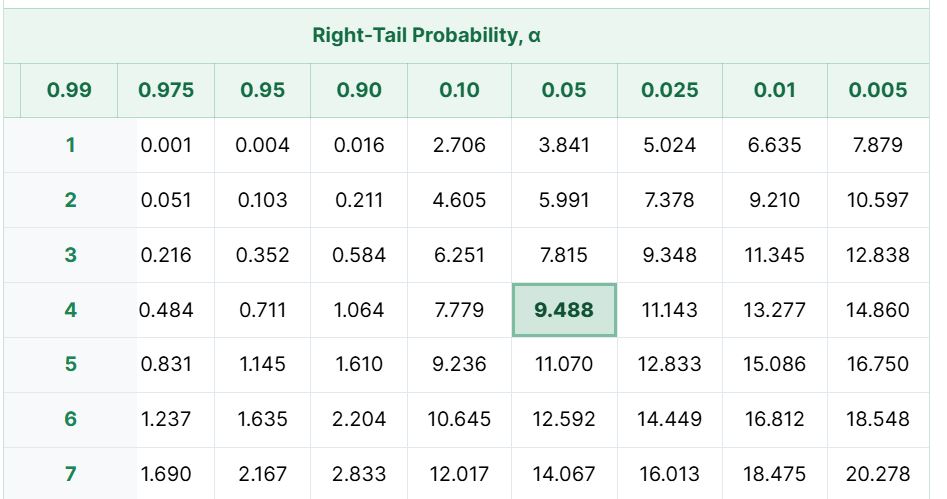
You can also verify these results using the calculator and following these steps:
- Select right-tailed as the test type
- Enter df = 4 and α = 0.05
- Click calculate
The calculator will instantly return the right-tailed chi-square critical value as χ² = 9.4877 (similar to the table results).
Scenario B: The Left-Tailed Test
To find the left-tailed chi-square critical value for the test using the right-tailed chi-square table, follow these steps:
- Identify the significance level. Since this is a left-tailed test, we use 1 – 0.05 = 0.95
- Find the degrees of freedom. The degrees of freedom remain the same. That’s, df = 4
- Locate the value at the intersection of the df = 4 row and the α = 0.95 column. The value is 0.711.
Therefore, the left-tailed chi-square critical value for the test is: χ²1-0.05, 4 = 0.711.
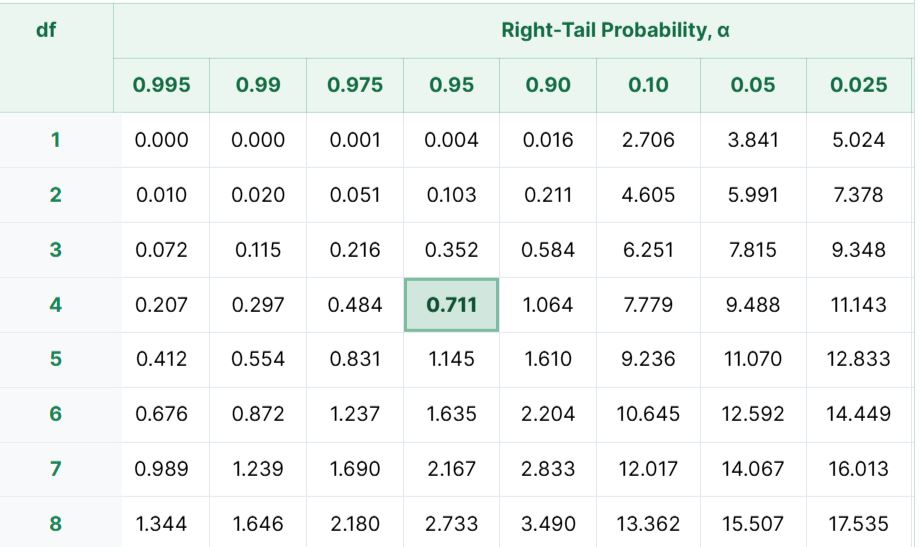
You can also verify these results using the calculator and following steps:
- Select left-tailed as the test type
- Enter df = 4 and α = 0.05
- Click calculate
The calculator will instantly return the left-tailed chi-square critical value as χ² = 0.7107 (similar to the manual steps solution)
Scenario C: The Two-Tailed Test
To find the two-tailed chi-square critical values for the test using df = 4 and α = 0.05, follow these steps:
- Find the upper table probability. By definition, the upper tail probability for a two-tailed test is α/2 = 0.025
- Find the lower table probability. By definition, the lower tail probability for a two-tailed test is 1- α/2 = 1-0.025 = 0.975
- Look up the value where df = 4 meets with probability = 0.025 and where df = 4 meets with probability = 0.975.
The degrees of freedom, df = 4, meet the upper table probability (α/2 = 0.025) at 11.143, as shown below.
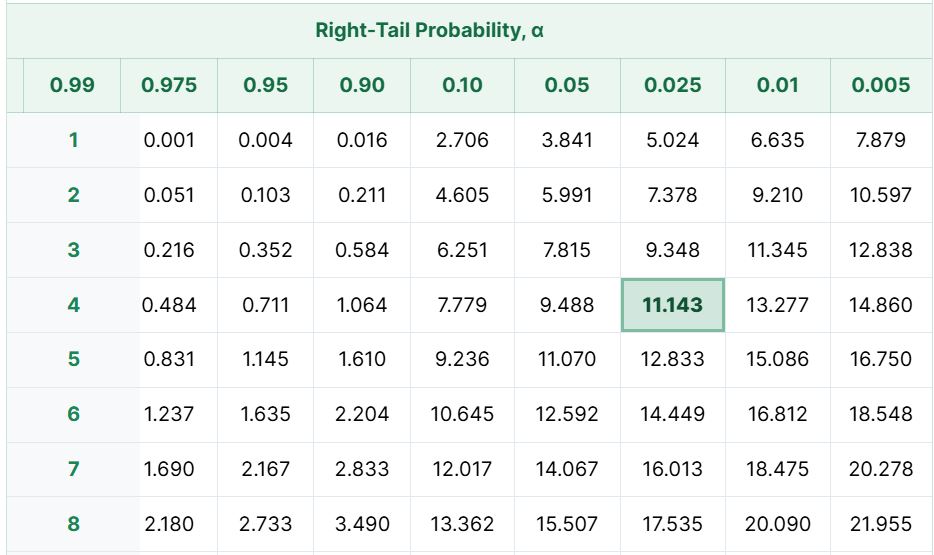
On the other hand, the df = 4 meets the lower probability (1- α/2 = 0.975) at 0.484, as shown below.
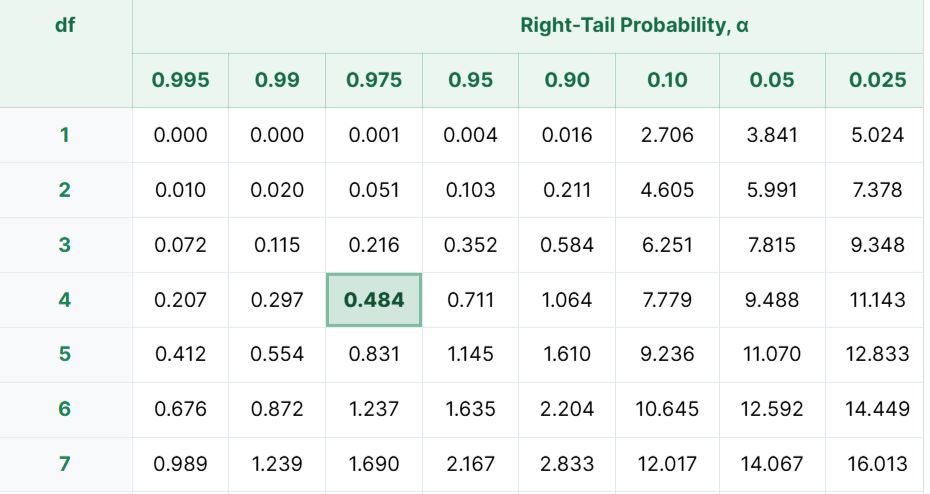
Therefore, the two-tailed chi-square critical values for the test are: 0.484 and 11.143.
Alternatively, you can use the calculator to get instant results. Just follow these steps:
- Select two-tailed as the test type
- Enter df = 4 and α = 0.05
- Click calculate
The calculator will instantly return the two-tailed chi-square critical value as follows:
- Lower critical value, χ² = 0.4844
- Upper critical value, χ² = 11.1433
T
Frequently Asked Questions
This calculator finds the chi-square critical value for a selected test type, significance level, α, and degrees of freedom, df. It supports right-tailed, left-tailed, and two-tailed chi-square critical values.
Select the test type, enter the significance level, α, and degrees of freedom, df, then click Calculate. The calculator will show the chi-square critical value and explain how the value is obtained from a chi-square table.
Choose right-tailed for most chi-square goodness-of-fit tests, tests of independence, and tests of homogeneity. However, when working with certain variance or standard deviation problems, choose left-tailed or two-tailed.
Right-tailed is selected by default because most common chi-square tests use the right tail. In these tests, larger chi-square statistics provide stronger evidence against the null hypothesis.
Yes. The calculator gives the result instantly, but the step-by-step solution explains the same lookup process used in a chi-square table.
