
How to Use the F Critical Value Calculator
To use the calculator, follow these steps:
- Enter the significance level, α.
- Enter the numerator degrees of freedom, df1.
- Enter the denominator degrees of freedom, df2.
- Click Calculate.
The calculator will instantly return the right-tailed F-critical value for the most common F-tests, including ANOVA, F-test for equality of variance, regression, etc. It will also provide you with a clear, step-by-step solution showing you exactly how you would find the same critical value using the F-table.
Note. Most F tests use a right-tailed critical value. This includes common tests such as ANOVA, regression F tests, and many variance comparison problems. That is why this calculator focuses on the right-tailed F critical value most students and researchers actually need.
What Is an F Critical Value?
An F critical value is a cutoff value obtained in F-distribution tables and widely used in hypothesis tests to determine whether the results are statistically significant or not. The value is compared with the computed F-statistic value, and the decision rule is as follows:
- Reject the null hypothesis (H0) if the F-statistic is greater than the F-critical value
- Fail to reject the null hypothesis (H0) if the F-statistic is less than the F-critical value
Example. Suppose a researcher conducted an ANOVA test and obtained an F-statistic value of 4.20 and a critical F value of 3.35. In this case, the researcher would reject the null hypothesis because the F-statistic (4.20) is greater than the F-critical (3.35).
Tips.
- The F-statistic is also known as the F-calculated, or F-observed
- The F-critical is also called F-tabulated
F Critical Value Formula
This calculator uses the inverse cumulative distribution of the F distribution to find the right-tailed F-critical value. The formula is: Fcritical=F−1(1−α; df1,df2)
Where:
- α is the significance level.
- df1 is the numerator degrees of freedom.
- df2 is the denominator degrees of freedom.
- F−1 is the inverse cumulative distribution function of the F distribution.
However, if you’re using F-tables, you don’t have to use the inverse because most F-distribution tables you’ll come across are right-tailed.
How to Find an F Critical Value
You can find an F critical value using an F table or an F critical value calculator.
To find the value manually using the table:
- Choose the significance level, α.
- Find the numerator degrees of freedom, df₁, and the denominator degrees of freedom, df₂.
- Select the correct F-table by α level
- Look up the value where the df₁ column and df₂ row meet for a chosen significance level.
Example 1
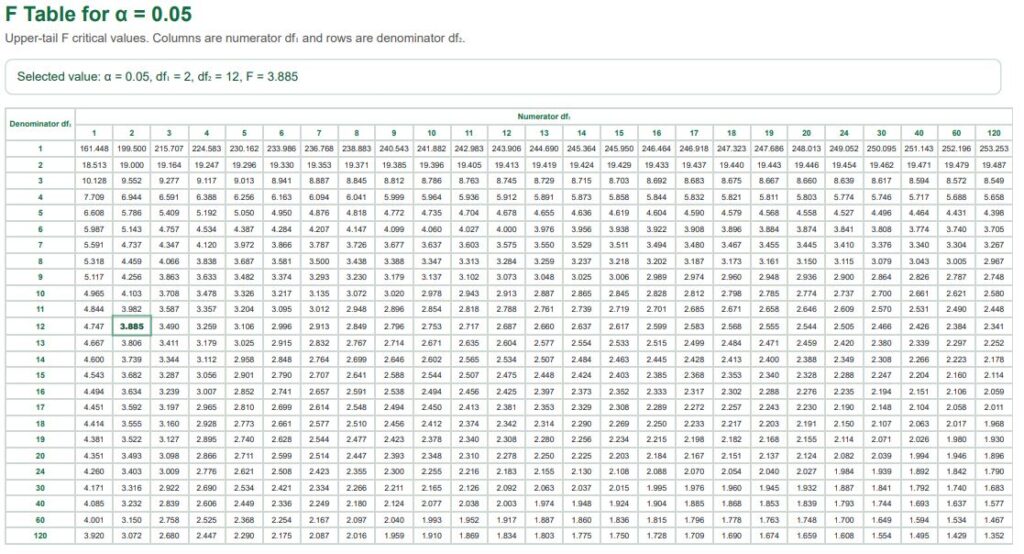
Find the F-critical value for a hypothesis test problem with α = 0.05, df₁ = 2, and df₂ = 12.
Solution
we can find the F-critical value using the tables as follows:
- Select an F-table for the 0.05 significance level
- Find the numerator df₁ = 2 column and denominator df₂ = 12 row.
- The df₁ = 2 column and df₂ = 12 row meet at 3.885, as shown below.
Want to learn more about how to find critical F values using tables? Use the F distribution table.
Want to verify the results using the calculator? Follow these steps:
- Enter 0.05 in the significance level input field
- Enter df1 = 2 and df2 = 12
- Click calculate
The calculator will instantly return the F critical value as 3.8853 (similar to the manual procedure).
Example 2
A researcher conducted a one-way ANOVA to determine whether there was a significant difference in test scores among students taught using four different teaching methods. The study included a total sample of 40 students. Using a 5% significance level, find the appropriate critical value for the test and provide the decision rule.
Solution
From the question, a one-way ANOVA was conducted. Thus, before finding the critical F-value using the calculator, we need to determine the correct degrees of freedom.
For a one-way ANOVA:
- The numerator degrees of freedom, df1 = k-1, where k is the number of groups.
Since there are 4 teaching methods, then k = 4. Therefore, df1 = 4-1
= 3
- The denominator degrees of freedom, df2 = n-k, where n is the sample size
Since the total sample size is 40, then n = 40. Therefore, df2 = 40-4
= 36.
Now, since we already have all the parameters required in the calculator, we can quickly find the f-critical values as follows:
- Enter 0.05 in the significance level input field
- Enter 3 in the numerator degrees of freedom (df1) input field
- Enter 36 in the denominator degrees of freedom (df2) input field
- Click Calculate
The calculator will instantly return the correct F-critical value for the test as 2.8663. Therefore, the researcher should reject the null hypothesis if the calculated F-statistic from the ANOVA table is greater than 2.8663. Otherwise, the researcher should fail to reject the null hypothesis.
Note: While using the calculator or an F table to find the F-critical value, always enter df1 and df2 in the correct order. Reversing them can produce a wrong F critical value.
How to Find the Correct Degrees of Freedom for Common F-Tests
Finding the correct numerator and denominator degrees of freedom for an F-test determines whether the critical F-value is correct or not. The correct df1 and df2 vary by the type of F-test you’re conducting.
The table below provides a quick summary of how to determine the correct degrees of freedom for common F-tests.
| Test | Numerator degrees of Freedom (df1) | Denominator degrees of freedom (df2) |
|---|---|---|
| One-way ANOVA | k−1 | n−k |
| Regression F-test | p | n−p−1 |
| Two-sample variance F-test | n1−1 | n2−1 |
Where:
- k is the number of groups in a one-way ANOVA
- n is the total sample size
- p is the number of predictors in a regression model
- n1 and n2 are the sample sizes for the two groups in a variance test
Tip. The correctness of the F-critical values depends heavily on using the correct degrees of freedom. Therefore, if you’re unsure how many degrees of freedom to use for your test, the degrees of freedom calculator might be useful.
When Should You Use This Calculator?
This calculator is useful for:
- One-way ANOVA, when comparing the means of three or more groups.
- Two-way ANOVA, when testing main effects or interaction effects.
- Regression F-tests, when checking whether the overall regression model is statistically significant.
- Variance ratio tests, when comparing two sample variances.
- Statistics homework or exam questions, when you are given α, df1, and df2 and asked to find the F critical value.
Frequently Asked Questions
This calculator finds the right-tailed F critical value using the significance level (α), numerator degrees of freedom (df1), and denominator degrees of freedom (df2). It also shows you how you would find the same results using the F-tables.
Yes. You can use this calculator for one-way ANOVA, two-way ANOVA, and other ANOVA-based F-tests provided you enter the correct parameters,α, df1, and df2.
This calculator focuses on the right-tailed F critical value because most ANOVA and regression F-tests use the right tail. In these tests, large F statistics provide stronger evidence against the null hypothesis.
Use the alpha value required by your study, assignment, or analysis plan. If no alpha value is given, use the default, α = 0.05, which is commonly used in many statistics problems.
Yes. For an overall regression F-test, enter the model degrees of freedom as df1 and the residual degrees of freedom as df2. In a multiple regression model, you can find the correct degrees of freedom using these formulas:
– df1 = p
-df2 = n-p-1
where p is the number of predictors and n is the sample size.
No. The F statistic is calculated from your sample data, while the F critical value comes from the F distribution using α, df1, and df2.
Compare it with your calculated F statistic. If the F statistic is greater than the F critical value, reject the null hypothesis.
