
How to Use the T Critical Value Calculator
This calculator helps you find the one-sided and two-sided t-critical values and shows you how to find these values from the t-distribution table. To use the calculator:
- Select the type of test you’re conducting.
- Choose two-tailed if you’re testing whether a value is different from a claim.
- Choose left-tailed if you want to test the hypothesis that a value is less than the claim.
- Choose right-tailed if you are testing whether a value is greater than the claim.
- Enter the significance level (α) and the degrees of freedom (df)
- Click calculate
The calculator will instantly return the t-critical value for your selected type of test. It also provides a clear, step-by-step solution to help you understand how you can get this value from the t-table.
Tip. You should always choose the correct test type to get the correct critical t value. Additionally, the degrees of freedom vary depending on the type of t-test you’re performing.
What Is a T Critical Value?
A t critical value is a cutoff point on the t distribution, which defines the boundary between the rejection region and the non-rejection region in a t-based hypothesis test. It is also used when constructing confidence intervals.
In hypothesis testing, the t critical value is compared with the calculated t statistic to decide whether to reject or fail to reject the null hypothesis.
For a two-tailed test, use this decision rule:
- Reject the null hypothesis (H0) if the absolute value of the calculated t statistic is greater than the absolute value of the t critical value. In symbols, Reject H0 if ∣t∣>∣tcritical∣
- Fail to reject the null hypothesis (H0) if the absolute value of the calculated t statistic is less than or equal to the absolute value of the t critical value. In symbols, fail to reject H0 if ∣t∣≤∣tcritical∣
For a right-tailed test, reject H0 if the calculated t statistic is greater than the positive t critical value. However, for a left-tailed test, reject H0 if the calculated t statistic is less than the negative t critical value.
In confidence intervals, the t critical value is used as the multiplier for the standard error. It helps determine the margin of error around the sample estimate.
T Critical Value Formula
The exact t critical value is found from the inverse t distribution. The formula varies depending on the test type.
- For a right-tailed test, the t critical value formula is: tα, df
- For a left-tailed test, the t critical value formula is: -tα, df
- For a two-tailed test, the t critical values formula is: tα/2, df
where:
- α is the significance level
- df is the degrees of freedom
Tips:
- The t-critical value for a right-tailed t-test is always positive
- The t-critical value for a left-tailed t-test is always negative
- For a two-tailed t-test, you must get two critical values (one negative and one positive). This is why two-tailed t-critical values are often written with a ± symbol.
How to Find T Critical Value
Finding a t critical value manually usually involves using a t distribution table. To use the table, you need to know three things:
- Whether the test is one-tailed or two-tailed
- The significance level, α
- The degrees of freedom, df
Once you know these, you look up the row for df and the column for α. The value where the row and column meet is the t critical value.
Example 1. Two-Tailed Test
A researcher wants to test whether the average exam score of a sample of students is different from the national average. The researcher selects a sample of 16 students and uses a significance level of 0.05. Find the t critical value for this test.
Solution
From the question, we know that:
- The correct test is a one-sample t-test
- Sample size, n = 16
- Significance level, α = 0.05
- This is a two-tailed test because we want to test whether it is different from the national average.
By definition, the degrees of freedom formula for a one-sample t-test is: df = n-1
Thus, df = 16-1
= 15
To find the two-tailed t-critical value for this test using t tables, follow these steps:
- Find a two-sided t-distribution table
- Locate the df = 15 row and the α = 0.05 column
- Identify the value at the intersection
From the two-sided t-table, the value where df = 15 and α = 0.05 meets is 2.131, as shown below. Since this is a two-sided test, we write it as ±2.131.
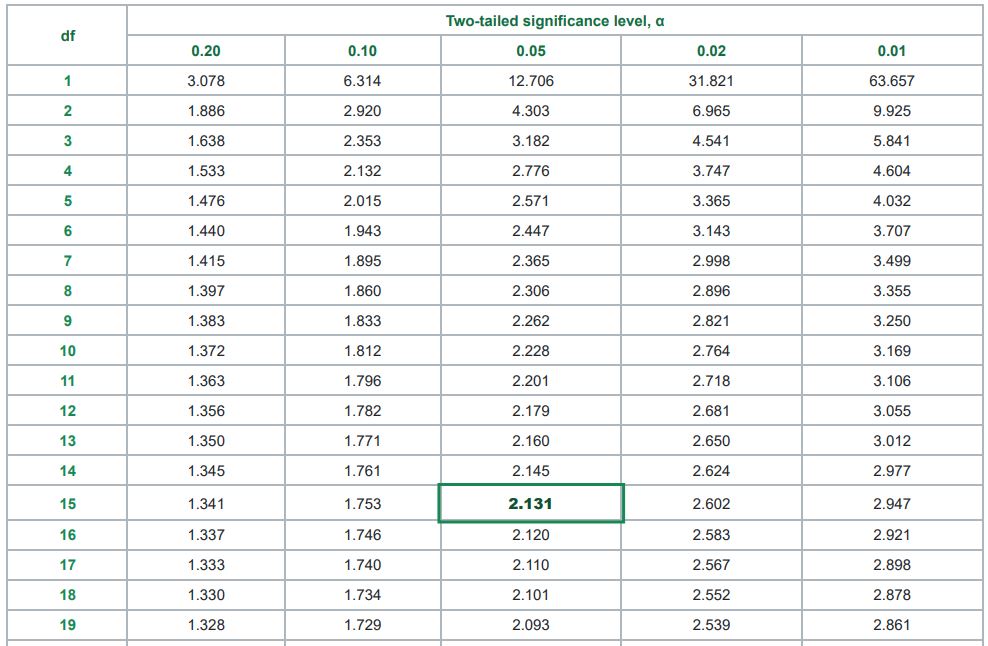
Alternatively, you can use the critical t-value calculator to get instant results by following these steps:
- Select two-tailed as the test type
- Enter α = 0.05 and df = 15
- Click calculate
The calculator will instantly return the two-sided t-critical value as ±2.1314, similar to the t-table results.
Example 2. One-Tailed Test
A physiotherapist wants to test whether a 6-week exercise program increases patients’ flexibility scores. The same 14 patients were measured before and after the program. The researcher uses a significance level of 0.05. Find the t critical value for this test.
Solution
This is a paired t-test because the same patients are measured twice (before and after the program).
From the question, we know that:
- Number of pairs, npairs=14
- Significance level, α =0.05
- This is a right-tailed test because the researcher wants to test whether flexibility scores increased after the program.
For a paired t-test, the degrees of freedom are: df = npairs−1
Therefore: df =14−1
=13
Therefore, to find the one-sided t-critical value for the test using t-tables, follow these steps:
- Find a one-sided t-table
- Locate the df = 13 row and α =0.05 column
- Identify the value at the intersection
The df = 13 and α =0.05 intersects at 1.771, as shown below. Therefore, the correct critical value for the test is: t0.05, 13 = 1.771.
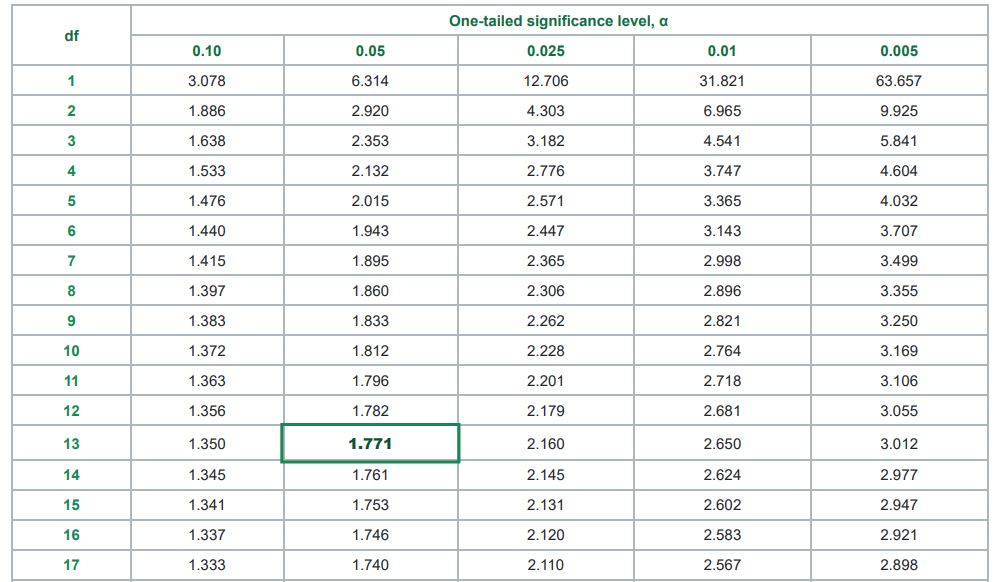
However, using the calculator, you only need to follow these steps
- Select right-tailed as the test type
- Enter α = 0.05 and df = 13
- Click calculate
The calculator will instantly return the right-tailed t-critical value as: t = 1.7709 (similar to the table results).
Want to quickly find the degrees of freedom for any t-test? Use the degrees of freedom calculator.
When Should You Use This Calculator?
Use this t critical value calculator when you need a cutoff value for a t-based hypothesis test or confidence interval.
You can use it for:
- One-sample t tests
- Paired-samples t tests
- Independent-samples t tests
- Left-tailed t tests
- Right-tailed t tests
- Two-tailed t tests
- Confidence interval problems that require a t-critical value
How do I know whether to choose left-tailed, right-tailed, or two-tailed?
Choose the test type based on the alternative hypothesis. The table below provides a quick summary of how to choose the correct test type.
| Test Type | Use It When |
|---|---|
| Left-tailed | You are testing whether a value is less than another value |
| Right-tailed | You are testing whether a value is greater than another value |
| Two-tailed | You are testing whether a value is different from another value |
For example, use a two-tailed test when the alternative hypothesis uses “not equal to.”
Frequently Asked Questions
A t critical value calculator finds the cutoff value from the t distribution for a selected test type, significance level, and degrees of freedom.
Choose the two-tailed option, enter the significance level (α), degrees of freedom (df), and click calculate. The calculator returns the positive and negative critical values for your two-sided t-test.
Choose the right-tailed option, enter the significance level (α), degrees of freedom (df) and click calculate. The result is a positive t critical value.
Choose the left-tailed option, enter the significance level (α), degrees of freedom (df) and click calculate. The calculator instantlys return the left-sided critical t-value.
Yes. You can use a t table when your significance level and degrees of freedom are listed. However, if your degrees of freedom are not availble in the table, the t-critical value calculator give more precise answers.
