
Want to calculate the median absolute deviation instead? Use the Median Absolute Deviation Calculator
How to Use the Mean Absolute Deviation Calculator
This mean absolute deviation calculator helps you find the average distance between each data point and the mean of a dataset. To use the calculator:
- Enter your data values in the input box. You can separate values using commas, spaces, tabs, or line breaks. The calculator also allows you to paste values directly from Excel, Google Sheets, and text documents
- Click Calculate.
The calculator will instantly return the mean absolute value and show you how it was calculated, step-by-step. This makes it useful when you want both the final answer and to learn how to calculate it using your own dataset.
What Is Mean Absolute Deviation?
Mean absolute deviation (MAD) is a statistical measure of spread that describes the average distance between each data value and the mean. In simple terms, MAD tells you how far the data points are from the mean, on average.
Struggling with interpreting mean absolute deviation? Here’s a quick guide:
- A low mean absolute deviation means the values are close to the mean.
- A high mean absolute deviation means the values are more spread out from the mean.
For example, suppose two classes have the same average test score, but one class has a larger MAD. The class with the larger MAD has scores that are more spread out around the mean.
Mean Absolute Deviation Formula
The mean absolute deviation formula is:
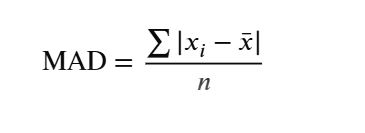
Where:
- MAD is the mean absolute deviation.
- xi represents each data value.
- x̄ is the mean of the dataset.
- |xi − x̄| is the absolute deviation of each value from the mean.
- n is the total number of values.
- Σ|xi − x̄| is the sum of absolute deviations from the mean
The absolute value signs are important because distance cannot be negative. A value below the mean and a value above the mean can both be the same distance away from the mean.
How to Find Mean Absolute Deviation
To calculate the mean absolute deviation manually, follow these steps:
- Find the mean of the dataset.
- Find the absolute deviations
- Add the absolute deviations.
- Divide the sum of absolute deviations by the number of values.
Example
A teacher records the number of minutes taken by 6 students to complete a task:
8, 10, 12, 15, 18, 21
Find the mean absolute deviation.
Solution
Step 1: Find the mean.
By definition, the mean formula is: x̄ = Σx / n
= (8 + 10 + 12 + 15 + 18 + 21)/6
= 84/6
Hence, x̄ = 14
Want to find the mean quickly and see the steps? Use the mean calculator.
Step 2: Find the absolute deviations.
To find the absolute deviations, we subtract the mean (x̄ = 14) from each value and take the absolute value. The table below shows the complete steps.
| xi | |xi − x̄| |
|---|---|
| 8 | |8-14| = 6 |
| 10 | |10-14| = 4 |
| 12 | |12-14| = 2 |
| 15 | |15-14| = 1 |
| 18 | |18-14| = 4 |
| 21 | |21-14| = 7 |
Step 3: Add the Absolute deviations
To find the sum of absolute deviations, we need to add all values in the column, |xi − x̄|
Therefore, Σ|xi − x̄| = 6 + 4 + 2 + 1 + 4 + 7
= 24
Step 4: Divide the sum of absolute deviations by the number of values.
By definition, MAD = Σ|xi − x̄| / n
Since Σ|xi − x̄| = 24 and n = 6, it follows that:
MAD = 24/6
= 4
Therefore, the mean absolute deviation is 4. This means the task completion times are, on average, about 4 minutes away from the mean.
Why Do We Use Absolute Values?
When you subtract the mean from each data value, some deviations are positive while others are negative. Adding these positive and negative deviations from the mean will always be zero, and this would not help us measure the spread. Therefore, by taking the absolute value of each deviation, we’re able to find the average distance from the mean.
Mean Absolute Deviation vs Standard Deviation
Mean absolute deviation and standard deviation both measure spread. However, they differ in several aspects. The table below shows the key differences between these two measures of dispersion.
| Measure | How it measures spread | Simple meaning |
|---|---|---|
| Mean absolute deviation | Uses absolute distances from the mean | Average distance from the mean |
| Standard deviation | Uses squared deviations and then takes a square root | Typical spread around the mean |
Want to learn more about the standard deviation? Use the standard deviation calculator.
Frequently Asked Questions
This calculator finds the mean absolute deviation of a dataset. It shows the final MAD value and a step-by-step solution using your data.
Mean absolute deviation is the average absolute distance of the data values from the mean.
The formula is: MAD = Σ|xi − x̄| / n, where xi is each value, x̄ is the mean, and n is the number of values.
No. Mean absolute deviation uses absolute distances from the mean, while standard deviation uses squared deviations and then takes a square root.
Yes. Mean absolute deviation can be affected by unusually large or small values because it uses the mean as the center.
