
Want to find the standard error of the mean instead? Use the standard error calculator
How to Use the Standard Error of Proportion Calculator
This standard error of proportion calculator helps you find the standard error for a one-sample proportion, either from a given sample size and number of successes, or from a sample size and sample proportion.
To use the calculator:
- Choose the input type that matches your question.
- Enter the required values.
- Click Calculate
The calculator will instantly return the correct standard error of the sample proportion. It will also provide a clear, step-by-step solution, showing you exactly how the standard error was computed from your data. This approach ensures that you not only get accurate results but also learn how to compute the standard error for a one-sample proportion manually.
Note. This calculator supports two options, which depend on the type of information you have. Here’s how to choose the right option:
- If you know the number of successes in the sample and the sample size, use the success and sample size option and enter x and n
- However, if the sample proportion is already given in your question, use the proportion and sample size option and enter p̂ and n
What Is the Standard Error of a Proportion?
The standard error of a proportion measures the precision of a sample proportion by quantifying how much a sample proportion is expected to vary from the true population proportion due to random sampling variability. A smaller standard error means your estimate is more reliable, with a larger error suggesting that the sample proportion has more sampling variability.
In simple terms, the standard error of a proportion measures how much a sample proportion is expected to vary from the true population proportion because of random sampling.
Standard Error of Proportion Formula
By definition, the standard error of proportion formula is:
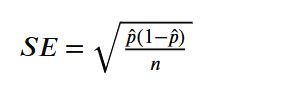
Where:
- SE is the standard error of the proportion.
- p̂ is the sample proportion.
- n is the sample size.
If the sample proportion is not provided, you can estimate it using the sample proportion formula: p̂ = x / n
Where:
- x is the number of successes.
- n is the sample size.
How to Calculate the Standard Error of Proportion
To calculate the standard error of a proportion manually:
- Find the sample proportion, p̂.
- Apply the standard error formula and solve
Tip. If the sample proportion is already given, you can skip calculating p̂ from x and n.
Example 1
In a university survey, 72 out of 180 randomly selected students said they prefer online classes. Find the standard error of the sample proportion.
Solution
Step 1: Find the sample proportion.
From the question, we know that:
- x = 72
- n = 180
To find the sample proportion, we use the sample proportion formula.
By definition, the sample proportion formula is: p̂ = x / n
Substituting the values into the formula, we get:
p̂ = 72 / 180
= 0.4
Step 2: Apply the standard error formula and solve
By definition, the standard error of proportion formula is: SE = √[p̂(1 − p̂) / n]
Substituting p̂ = 0.4 and n = 180 into the formula gives:
SE = √[0.4(1 − 0.4) / 180]
= √[0.4(0.6) / 180]
= √(0.001333)
Hence, SE = 0.036515
You can also verify these results using the standard error for proportion calculator as follows:
- Select the successes and sample size option
- Enter x=72 and n = 180
- Click Calculate
The calculator will instantly return the standard error of the proportion as, SE = 0.036515.
As you can see, the manual steps and the calculator yields similar results. A standard error of 0.036515 suggest that if the university conducted the same survey many similar times, the sample proportions would typically differ from the true population proportion by about 3.7 percentage points.
Example 2
A researcher reports that the sample proportion of students who prefer online learning is p̂ = 0.62. The sample size is 250. Find the standard error of the proportion.
Solution
Step 1: Identify the sample proportion.
From the question, we know that:
- p̂ = 0.62
- n = 250
In this case, p̂ is already given and we don’t need to apply the sample proportion formula.
Step 2: Apply the standard error formula and solve
By definition, the standard error of proportion formula is: SE = √[p̂(1 − p̂) / n]
Substituting p̂ = 0.62 and n = 250 into the formula gives:
SE = √[0.62(1 − 0.62) / 250]
= √[0.62(0.38) / 250]
=√(0.0009424)
Hence, SE = 0.030699
To verify this using the standard error of proportion calculator, follow these steps:
- Select the proportion and sample size option
- Enter p̂ = 0.62 and n = 250
- Click calculate
The calculator instantly return the standard error as: SE = 0.030699.
As you can see, both the calculator and the manual steps yield the same results. In this case, a standard error of 0.030699 suggests that if the same survey was conducted many times, the sample proportion would differ from the true population proportion by about 3.1 percentage points.
When to Use this Calculator
Use this standard error of proportion calculator when you are working with one sample proportion and want to understand how much that proportion may vary from the true population proportion.
This calculator is especially useful when:
- Measuring the precision of a sample proportion, with a smaller standard error indicating that the sample proportion is more precise.
- Constructing confidence intervals for population proportions. In this case, you multiply it by the critical value to get the margin of error.
- Reporting research findings involving proportion. Here, the standard error helps you describe the uncertainty around a sample proportion.
- Solving statistics homework problems. Using this calculator, you’ll not only get the answer but also learn how to compute the standard error using your own data.
Frequently Asked Questions
It calculates the standard error of one sample proportion. You can enter the number of successes and sample size, or enter the sample proportion and sample size directly.
The standard error of a proportion measures how much a sample proportion is expected to vary from the true population proportion because of random sampling.
The formula is: SE = √[p̂(1 − p̂) / n], where p̂ is the sample proportion and n is the sample size.
Yes. In general, increasing the sample size reduces the standard error, making the sample proportion more precise.
This calculator is for a one-sample proportion. A separate two-proportion calculator should be used when comparing two independent proportions.
